
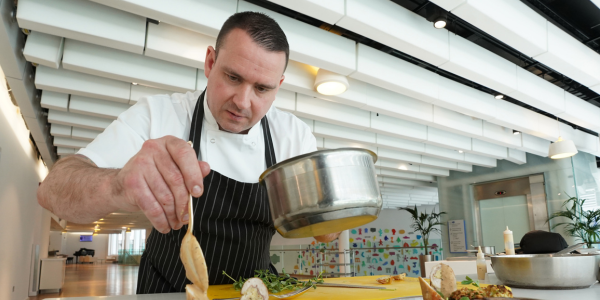
As International Chefs Day celebrates the culinary profession on 20 October, Paul Hood, Executive Head Chef at EICC Nourish, the in-house culinary team at Edinburgh International Conference Centre (EICC), shares what he would want any young person to know about food and about life in a professional kitchen.
This year’s Food Explorers campaign encourages young people to find out more about ingredients, their origins and how food is grown or harvested.
At EICC, Paul is already putting this into practice through the venue’s new tasting kitchen, where students, apprentices and future chefs can get hands-on with Scottish produce, sustainable cooking techniques and menu development through workshops, tastings and demonstrations.
Paul has spent more than two decades in kitchens and hospitality, including senior roles at Edinburgh’s Prestonfield House and The Dunstane Hotel. His commitment to learning and development was recognised in September when he was announced as the winner of the Scotland Food & Drink and HIT Scotland Legacy Scholarship. As part of the scholarship, he has secured a five-day ‘stage’ at The Dorchester in London’s Mayfair, working under Culinary Director Martyn Nail.
His cooking is also now available beyond EICC through the newly launched Nourish Event Catering, which brings the team’s approach to Scottish produce and sustainable catering to businesses and events across Edinburgh.
“The first thing I’d want a young person to understand is where their food comes from and the people behind it,” he says. “Scotland is home to exceptional producers, and every ingredient has a story.”
On provenance
One of Paul’s favourite ingredients is the Orkney scallop, harvested from the clean, cold waters around Orkney. It demonstrates why provenance matters to him, both in terms of the quality of the ingredient and for the people who produce it.
The EICC Nourish menus follow the same thinking. The team takes a plant-forward approach and looks for ways to use as much of an ingredient as possible. Broccoli, for example, can be used from stem to leaf, with the stalk fermented or preserved and the leaves lightly fried for texture and crunch.
Making the most of every ingredient
Reducing waste is fundamental in a high-volume events kitchen. Vegetable peels can become soups, stocks and seasonings, while surplus ingredients can be preserved or smoked to extend their use.
“Root-to-tip and nose-to-tail cooking have always been part of how we cook and develop menus. It’s about respecting the ingredient, reducing waste and finding value in every element.
“Every ingredient has a journey, from the farmer, fisher or grower to the plate in front of them. Understanding that story helps build a deeper appreciation for food and the people behind it.”
Skills that stay with you
Paul believes fish cookery is one of the most important skills for a young chef to master.
“Fish is often misunderstood and can be easily overcooked,” he says. Learning how different species behave, getting the temperature right and knowing when the fish is perfectly cooked all take practice, but they also build confidence and precision.
His own career has involved plenty of learning along the way. Molecular cooking was not part of his formal training, but he picked up techniques such as gels, foams and flavour encapsulation through professional development, working with other chefs and simply being curious.
For Paul, these techniques have their place, but they should never get in the way of the ingredient itself.
More than cooking
Paul also wants young people to understand that being a chef involves much more than preparing food.
“It takes a huge amount of dedication, resilience and hard work, but it is also one of the most rewarding careers you can choose. Being a chef is about far more than cooking; it’s about creativity, teamwork, leadership and continuous learning.”
That is something he also sees through mentoring. He believes one of the most rewarding parts of the job is watching a young chef develop the confidence to take ownership, make decisions and eventually support others in the team.
EICC also works with Social Bite through its Jobs First programme, supporting people affected by homelessness into employment. It is another example of how the venue is creating opportunities for people to build confidence, experience and skills within hospitality.
“There comes a point when you can rely on them to deliver consistently, make decisions and support others in the team. Seeing that progression from learner to trusted professional is a great achievement, both for them and for the mentor who has helped guide their journey.”
For Paul, that combination of learning, curiosity and experience is at the heart of developing the next generation. It is also central to this year’s Food Explorers theme, encouraging young people to look beyond what is on their plate and understand the ingredients, producers and skills behind it.
Related
![EICC[1]](https://eventsbase.co.uk/wp-content/uploads/2025/07/EICC1.png "EICC appoints new Chief Executive")